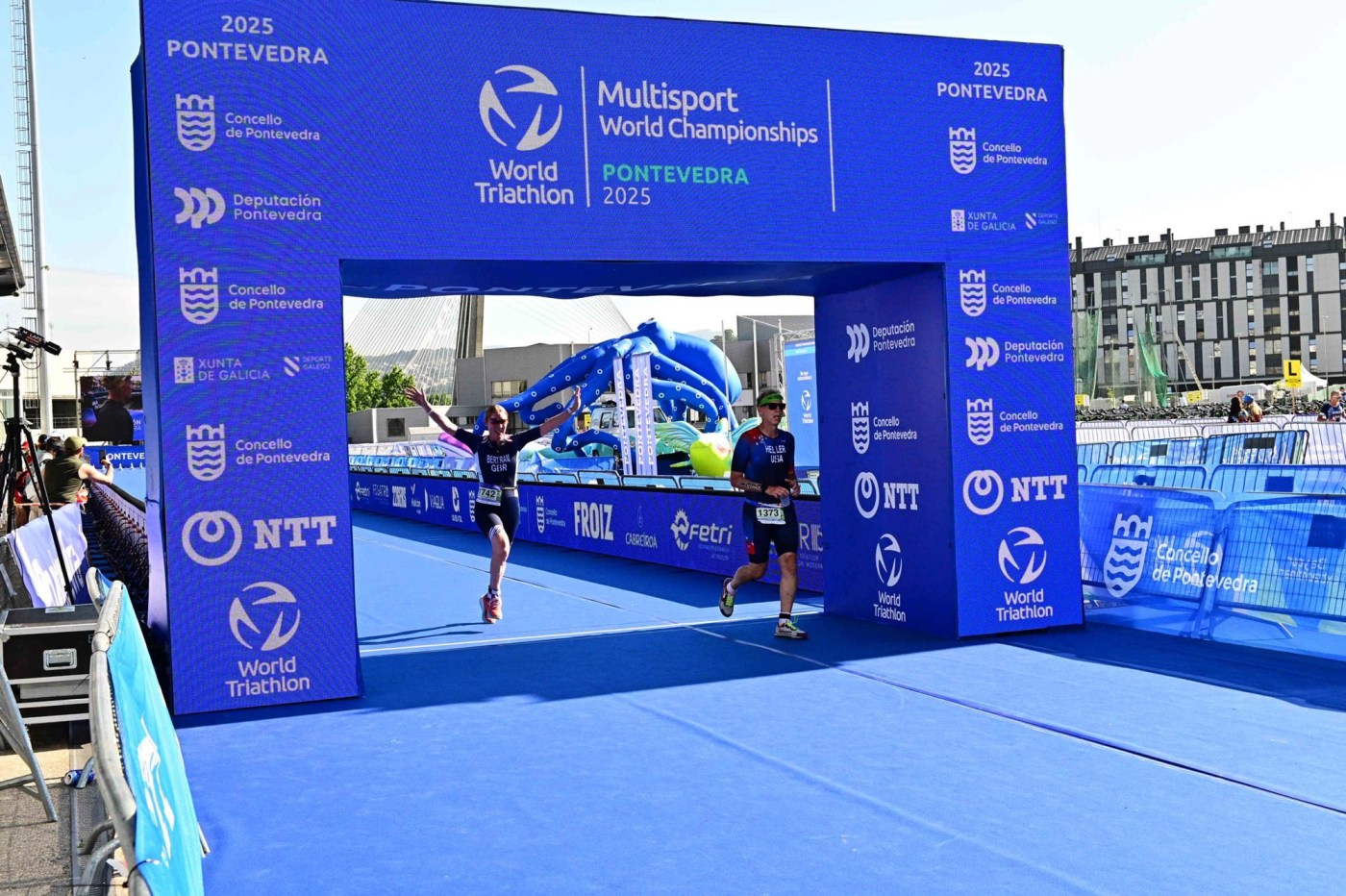
Over the past few years, I’ve come to realise that health and fitness are gifts we can’t take for granted. The ability to train, to race, to push myself—it’s not guaranteed forever. This was for Jenni, one of our closest friends who recently passed away from cancer, she was such a phenomenal athlete and the most amazing human being that we were so fortunate to call our friend.
Oh, and did I mention I turn 50 this year so I thought it’d also just be a pretty cool thing to do, 13 years since my first World Championships.

I qualified for the World Championships in May 2024 at Darley Moor. It’s a circuit I know well from criterium racing, so I felt confident going into a draft-legal duathlon there. The weather, however, had other plans. Torrential rain turned the run course into a waterlogged, cross-country slog. I hadn’t been running much in the lead-up, so it was a brutal test. But the bike leg was where I knew I could be really competitive. I found a strong group of cyclists, and we worked together, picking off riders one by one. It was gritty, it was wet, it was hard—but that makes it all the much sweeter!
Training: The Best Part of the Race
For me, the best part of any race is the training. It’s the structure, the focus, and the sense of purpose that gets you out the door—even on the days when you can think of a million excuses not to. Having a goal like the World Championships gave me that extra push, and I found myself falling back in love with the process.
I got into a solid routine, starting with Monday night track sessions with Charnwood Athletic Club. It had been a long time since I’d trained that consistently—probably not since before Covid—and seeing the improvements week by week was incredibly satisfying. It felt good to be back out there, surrounded by others chasing their own goals, and to feel my fitness steadily returning.
Over the winter, I also got back into my long Saturday runs, gradually building up to off-road half marathons in the mud. While that kind of endurance wasn’t strictly necessary for the duathlon distance, it gave me a strong aerobic foundation to build on.
On the bike, I kept things varied with two to three Zwift sessions each week and aimed to get out on the road at least once. As spring arrived, I shifted gears—cutting back the long runs and introducing a brutal brick session: 10 minutes on the turbo followed by a mile run, both at race intensity, repeated five times. It was horrible—but it worked. In the final weeks before the race, I could feel a real difference in how my body handled the transitions.
To make race day feel as familiar as possible, I even started doing these sessions in my GB tri-suit and race shoes. It might sound small, but normalising the kit and the feel of race pace helped me mentally and physically prepare for what was to come.
Pre-Race: Soaking in the Atmosphere in Pontevedra
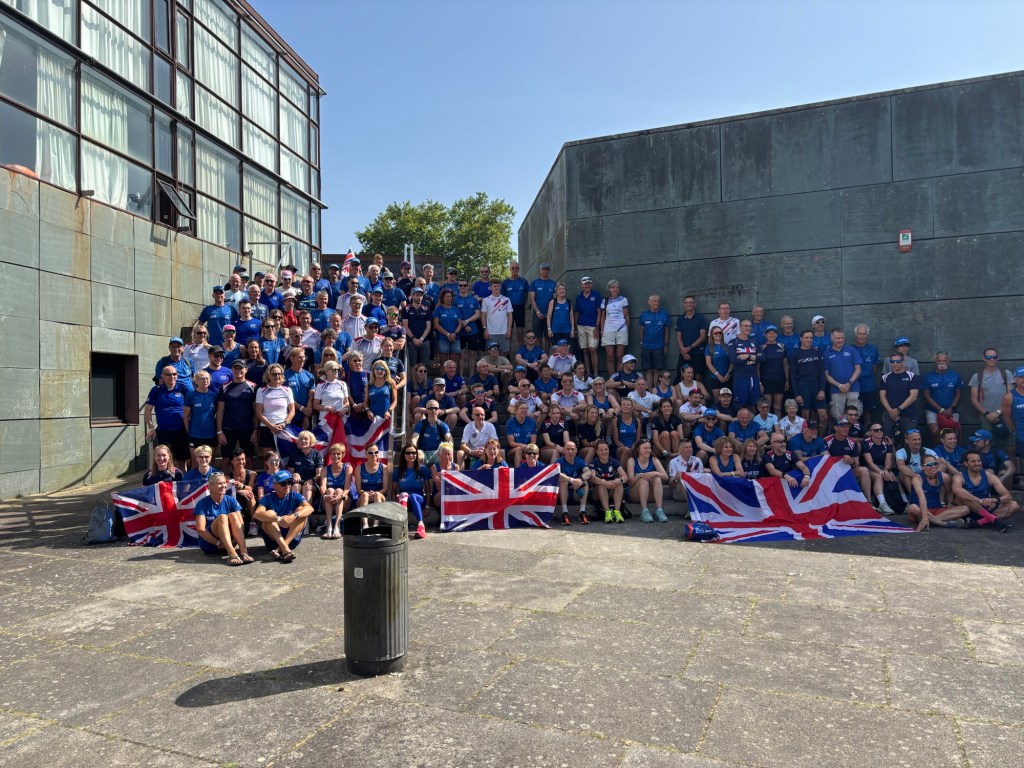
Arriving in Pontevedra for the World Duathlon Championships was a surreal and unforgettable experience. After months of training and anticipation, I was finally there—surrounded by athletes from all over the world, each with their own story and journey to the start line. The town was alive with energy: flags flying, volunteers bustling, and a real sense of celebration in the air.
This time, I made a conscious decision to soak it all in. In the past, I’d kept my engagement with pre-race events to a minimum, thinking it might heighten my nerves. But for Pontevedra, I flipped it in my mind. I told myself I wasn’t nervous—I was excited. And with that mindset, I embraced everything the event had to offer.
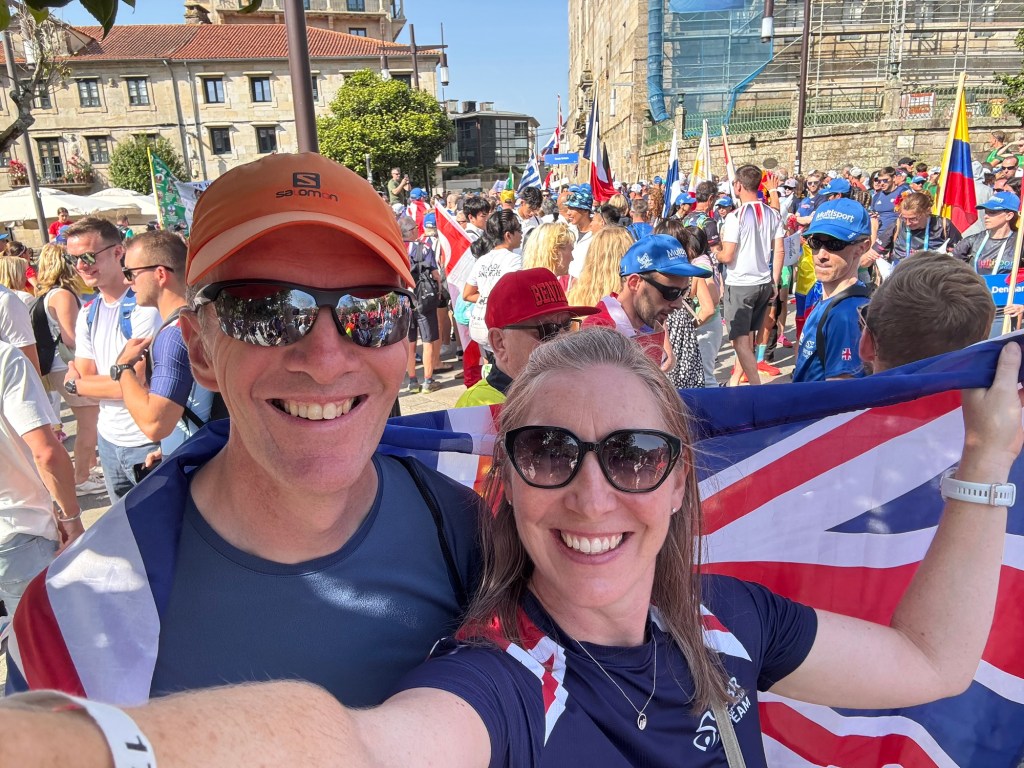
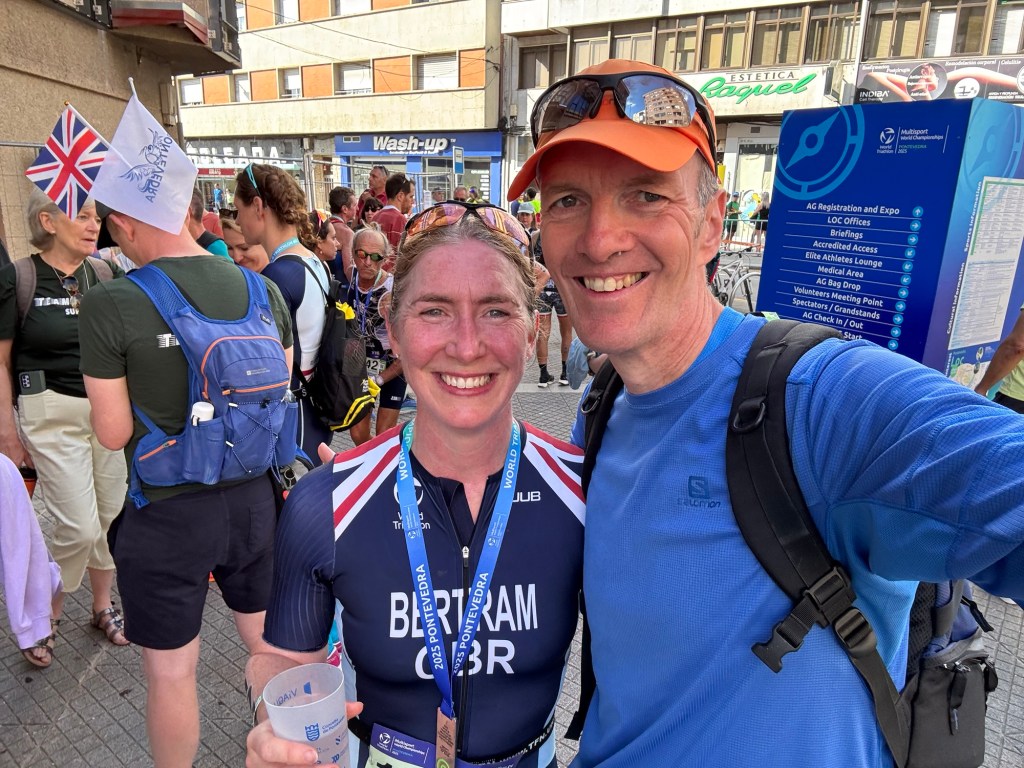
We explored the expo, enjoyed the buzz of registration, and took part in the Parade of Nations—an incredible moment of unity and pride, walking alongside fellow Team GB athletes and competitors from across the globe. Wearing the national kit and hearing cheers from the crowd made it all feel very real, and very special.
I also took time to recce the course, check out the transition area, and mentally walk through race day. It helped settle the nerves and gave me a sense of calm. But more than anything, I just tried to be present—to enjoy the build-up, the camaraderie, and the privilege of being part of something so big.
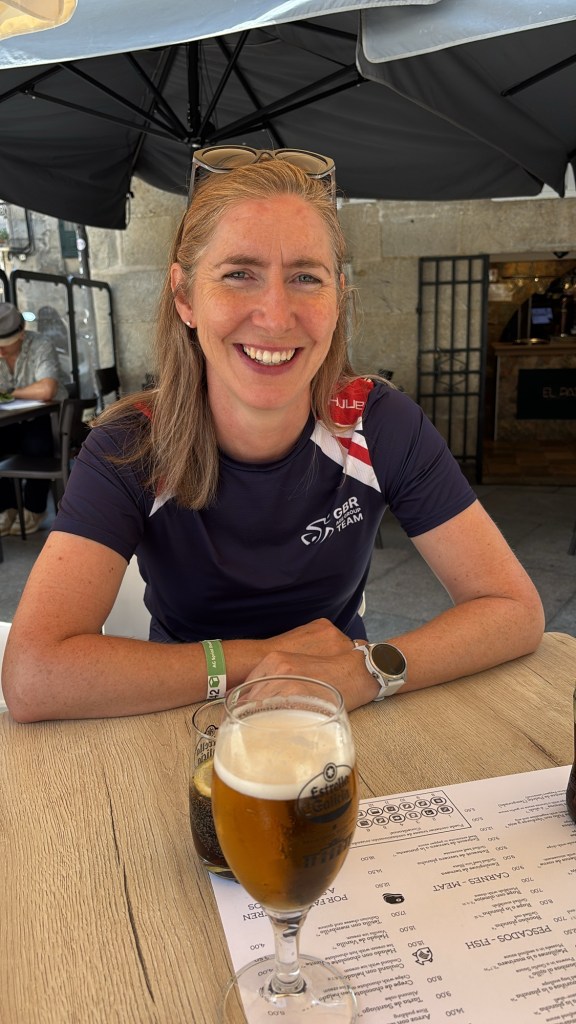
Race Day: Giving It Everything
I didn’t sleep well the night before—but that’s normal. Over time, I’ve learned to accept that pre-race restlessness is part of the process. Acknowledging it, rather than fighting it, makes a big difference.
We got down to transition around 7:30 a.m. I set everything up calmly, then milled around with the other athletes, soaking in the atmosphere. About 30 minutes before the start, I headed back into transition to warm up. My race wave went off fast—really fast. As we left the athletics track, I glanced at my watch and saw we were running at 5-something minute mile pace, which wasn’t quite what I’d planned! I gradually eased back to my planned pace of around 7-minute miles.
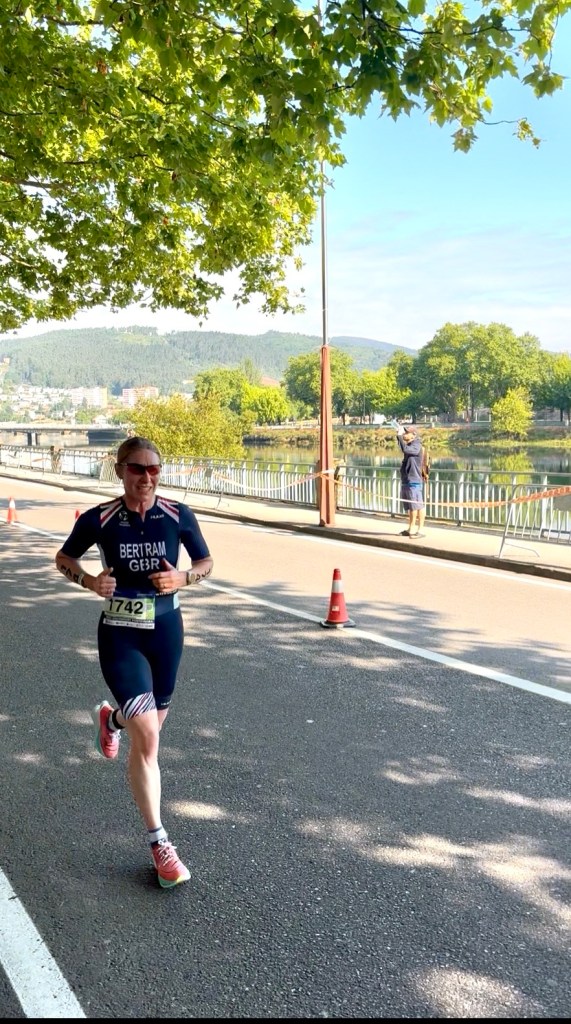
The run course was mostly flat with lots of sharp turns, two short but steep climbs, and a long, flowing descent where you could really open up. The first run was two laps of 2.5 km, which made it easy to break down mentally. I felt strong heading into transition—ready for my favourite part: the bike.
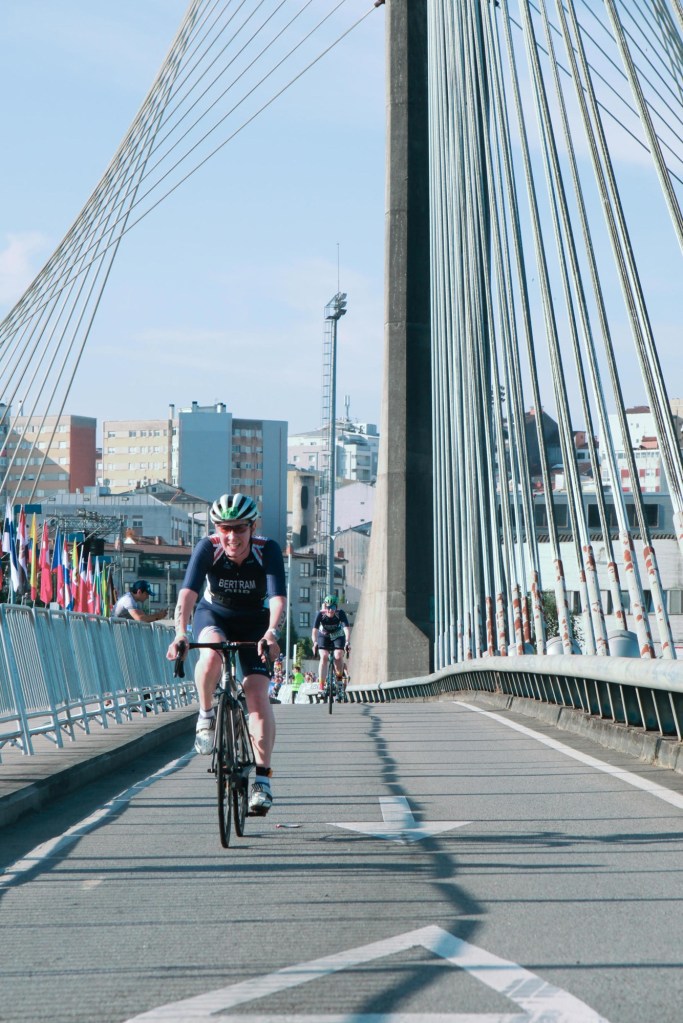
As we left Pontevedra and headed up the valley, the climbing began almost immediately. The gradient averaged around 6% all the way to the turnaround point. It was tough going, and although it was a draft-legal race, I didn’t find a group to work with. I just kept picking off riders one by one. I wasn’t getting passed until two Americans came past me, working together. I told myself, “Get on their wheel, just go hard, it’ll get easier once you’re there.” But I just couldn’t hold them.
The return leg was mostly downhill with a couple of small rises. In duathlon, age categories are marked on competitors’ calves, so I found myself constantly scanning legs, trying to work out who I was racing. I spotted a Mexican athlete in my age group and knew I had to pass her decisively. I surged past, trying to look calm and in control, hoping she wouldn’t try to follow.
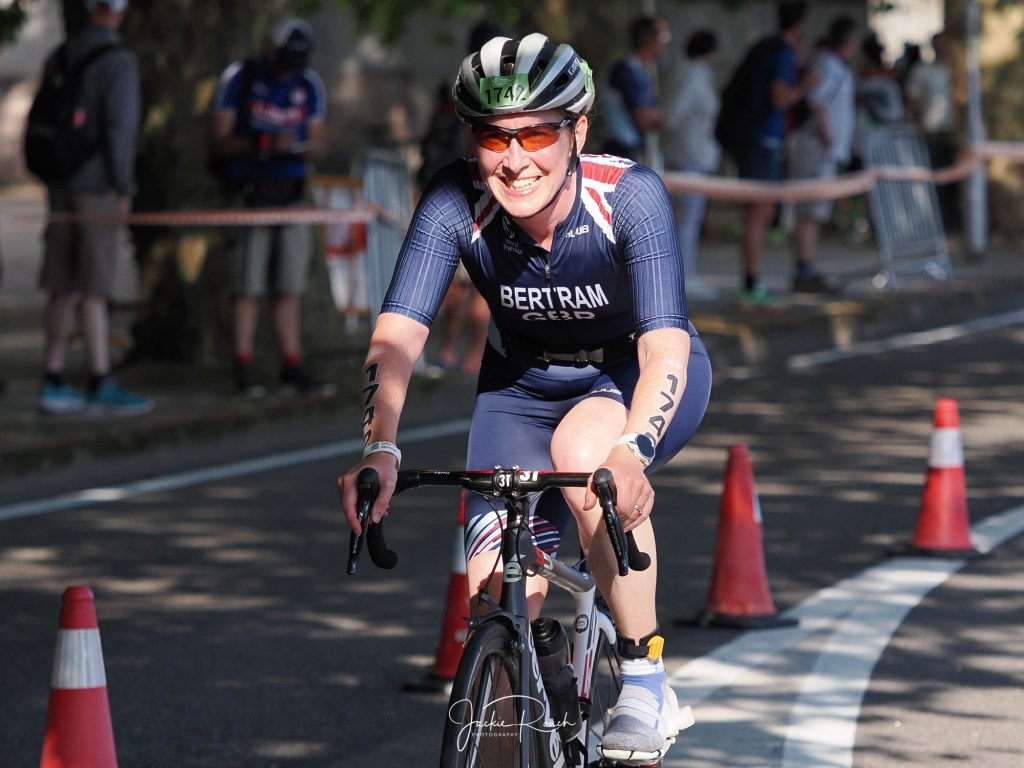
Coming back into transition, I slipped my feet out of my shoes and rode the final stretch with them on top of the shoes. Another smooth transition, and then it was time for the final 2.5 km run.
As I left transition, John shouted that I was in 5th place. I had no idea until that moment where I stood in my age group. That lit a fire. I started scanning again, looking for age group competitors. I saw the Mexican athlete again—she must have passed me in transition. I thought about sitting on her shoulder and waiting for a sprint finish, but as we hit the short, steep rise, she looks tired, this was my moment! I surged past her, giving everything I had while trying to look composed. At the next dead turn, I checked—I’d opened a gap. Now it was about holding on. I reminded myself that everyone else was hurting too.
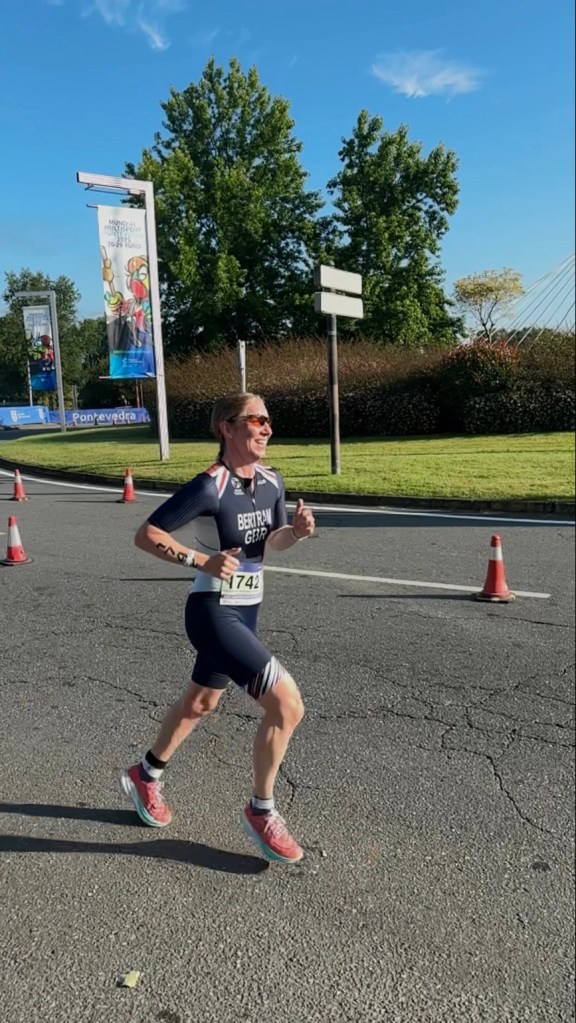
As I came down the final straight toward the track, John was there cheering me on. All I could think was “Nearly there, keep pushing on.” I hit the track with 250 metres to go. As I rounded the bend, I glanced over my shoulder—she was coming back for me. I was absolutely determined she wouldn’t get past. I emptied the tank in a full sprint and crossed the line just three seconds ahead.
It felt incredible. 5th in the world in my age group. I never truly let myself believe I could do that well. A marshal placed the medal around my neck, someone else removed my timing chip, and I stood there, barely able to stay upright. I had given it absolutely everything.

Reflections: A Shift in Belief
Crossing that finish line in Pontevedra wasn’t just the end of a race—it felt like the beginning of something new. For years, I’ve questioned whether I was good enough. Whether I was strong enough, fast enough, capable enough. I’ve always assumed others were better, more talented, more deserving to be on that start line. But this time, something changed.
For the first time, I truly believed I belonged. I didn’t just show up—I competed. I raced smart, I raced hard, and I held my own against some of the best in the world. Finishing 5th in my age group wasn’t just a result—it was a validation. A quiet but powerful shift from “Can I do this?” to “I can.”
This experience has reminded me that we’re often our own toughest critics. That the limits we perceive are often the ones we place on ourselves. And that sometimes, the biggest win isn’t a medal—it’s the belief that you’re just as good as anyone else out there.
 Bertie's World
Leave a comment